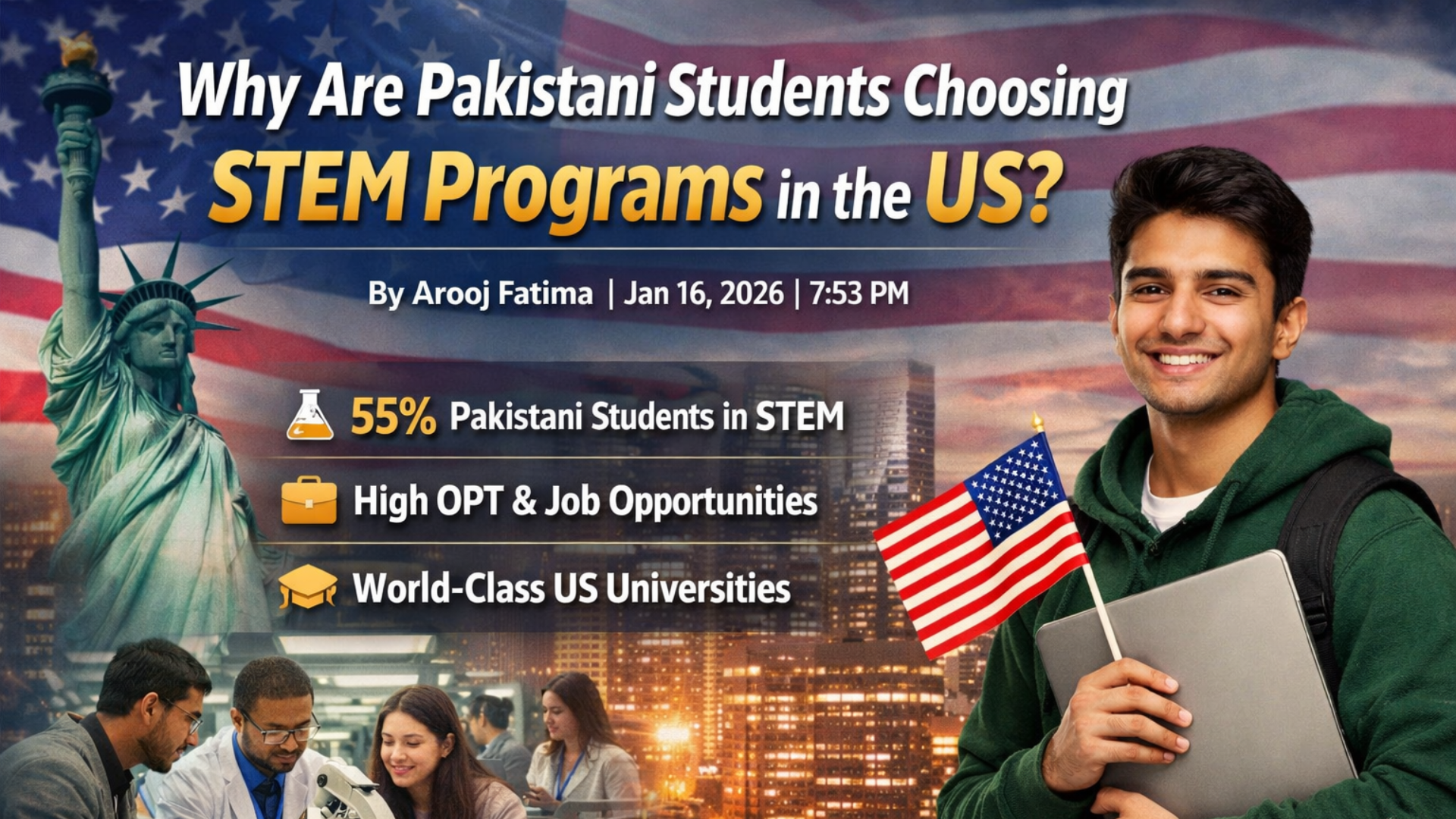

Why Are Pakistani Students Choosing STEM Programs in the US?. Pakistani students are increasingly choosing STEM programs in the United States, even as overall international enrolment growth slows. New data from the 2024–25 academic year shows a clear shift. While the US hosted nearly 1.2 million international students, new international enrolments dropped by 7%, mainly due to a 15% decline in graduate admissions.
Pakistani student enrolment in the US continued to rise, driven largely by strong demand for science, technology, engineering, and mathematics (STEM) degrees. This trend reflects changing student priorities, global job market realities, and the growing appeal of US-based education pathways that lead directly to employment.
Pakistani Students Buck the Global Enrolment Slowdown
Despite a broader slowdown in international student growth, Pakistani enrolment increased across both undergraduate and postgraduate levels.
- Undergraduate enrolment from Pakistan grew by 26% year over year in 2024–25
- Postgraduate enrolment rose by 18%, even as graduate enrolment declined globally
This growth highlights Pakistan as one of the few countries maintaining upward momentum in US higher education.
Education consultants and admission officers point to a more strategic mindset among Pakistani students. Instead of choosing destinations purely for prestige, students are now focused on return on investment, skills relevance, and long-term career security.
More Than Half of Pakistani Students Choose STEM
STEM fields dominate Pakistani student choices in the US.
During the 2024–25 academic year:

- Over 55% of Pakistani students enrolled in STEM programs
- 21% chose mathematics and computer science
- Nearly 20% enrolled in engineering disciplines
These numbers confirm a strong and sustained preference for technical and analytical fields.
Computer science, artificial intelligence, data science, and software engineering remain the most popular choices. These programs align closely with global hiring trends and offer stronger post-graduation employment prospects compared to non-STEM degrees.
Why STEM Programs Attract Pakistani Students
1. Strong Global Job Demand
STEM graduates continue to dominate global hiring pipelines. US-trained engineers, developers, and data specialists are in high demand across:
- Technology
- Finance
- Healthcare
- Research
- Manufacturing
For Pakistani students, a STEM degree offers mobility. It opens doors not only in the US but also in the Gulf, Europe, and remote global roles
2. Better Post-Study Work Opportunities
One of the biggest drivers behind STEM enrolment is Optional Practical Training (OPT).
STEM graduates are eligible for:

- Up to 36 months of OPT, compared to 12 months for non-STEM fields
Pakistani students increasingly see US education as a study-to-work pathway, not just an academic experience. Rising participation in OPT shows a clear focus on gaining US-based work experience after graduation.
3. Clear Link Between Education and Employment
Recent student surveys reveal a strong shift toward outcomes-driven decisions.
According to ApplyBoard’s Fall 2026 Recruitment Partner Pulse Survey:
- 91% of students prioritise affordability
- 88% prioritise post-study work opportunities
This near-equal importance shows that students no longer view education in isolation. Pakistani students, in particular, favour programs where education leads directly to employment and long-term career growth.
Why the United States Remains the Top Choice
Despite rising competition from Canada, the UK, and Australia, the US remains the preferred destination for Pakistani STEM students.
Key reasons include:

World-Class Universities
The US hosts a large number of globally ranked universities with advanced research facilities, industry partnerships, and innovation hubs.
Industry Exposure
US universities offer direct links to Silicon Valley, tech startups, research labs, and multinational corporations.
Flexible Degree Options
Students can:
- Switch majors
- Combine minors
- Transfer credits
- Move between institutions
This flexibility is especially attractive to students exploring fast-changing tech fields.
Undergraduate Growth Signals Early Career Planning
The sharp rise in Pakistani undergraduate enrolment suggests students are planning earlier.
Families are now investing in STEM education right after high school, instead of waiting for postgraduate studies. Early exposure to US education systems helps students:

- Build professional networks
- Access internships
- Develop research experience
- Compete better in global job markets
This shift marks a long-term change in how Pakistani families view overseas education.
Engineering and Computer Science Lead the Way
Among STEM fields, two areas dominate:
Computer Science and IT
Programs in:
- Software engineering
- Artificial intelligence
- Cybersecurity
- Data science
These fields offer remote work options and faster salary growth, making them highly attractive.
Engineering Disciplines
Mechanical, electrical, civil, and chemical engineering remain strong choices due to their versatility and global demand.
Economic Pressures Also Shape Decisions
Rising inflation and currency depreciation in Pakistan have made overseas education more expensive. As a result, students are becoming more selective.

STEM programs are seen as:
- Higher value
- More employable
- Faster return on investment
Students are choosing degrees that justify the financial sacrifice.
Challenges Still Exist
Despite the positive trend, Pakistani students face challenges:
- Visa processing delays
- High tuition fees
- Limited scholarships
- Housing and living costs
However, many believe the long-term benefits of STEM education outweigh these hurdles.
What This Trend Means for the Future
The steady rise of Pakistani students in US STEM programs signals a broader transformation:
- Education choices are becoming career-focused
- Students value skills over titles
- Employability matters as much as affordability
If current trends continue, Pakistan could emerge as one of the fastest-growing STEM student markets in US higher education over the next decade.
Conclusion
Pakistani students are choosing STEM programs in the United States because they offer practical skills, strong job prospects, and global career mobility. Even as international enrolment growth slows, Pakistan’s upward trend highlights a clear shift toward outcomes-driven education decisions.
With growing demand for technology and engineering skills worldwide, STEM education in the US remains a powerful pathway for Pakistani students seeking long-term success in an increasingly competitive global economy.