
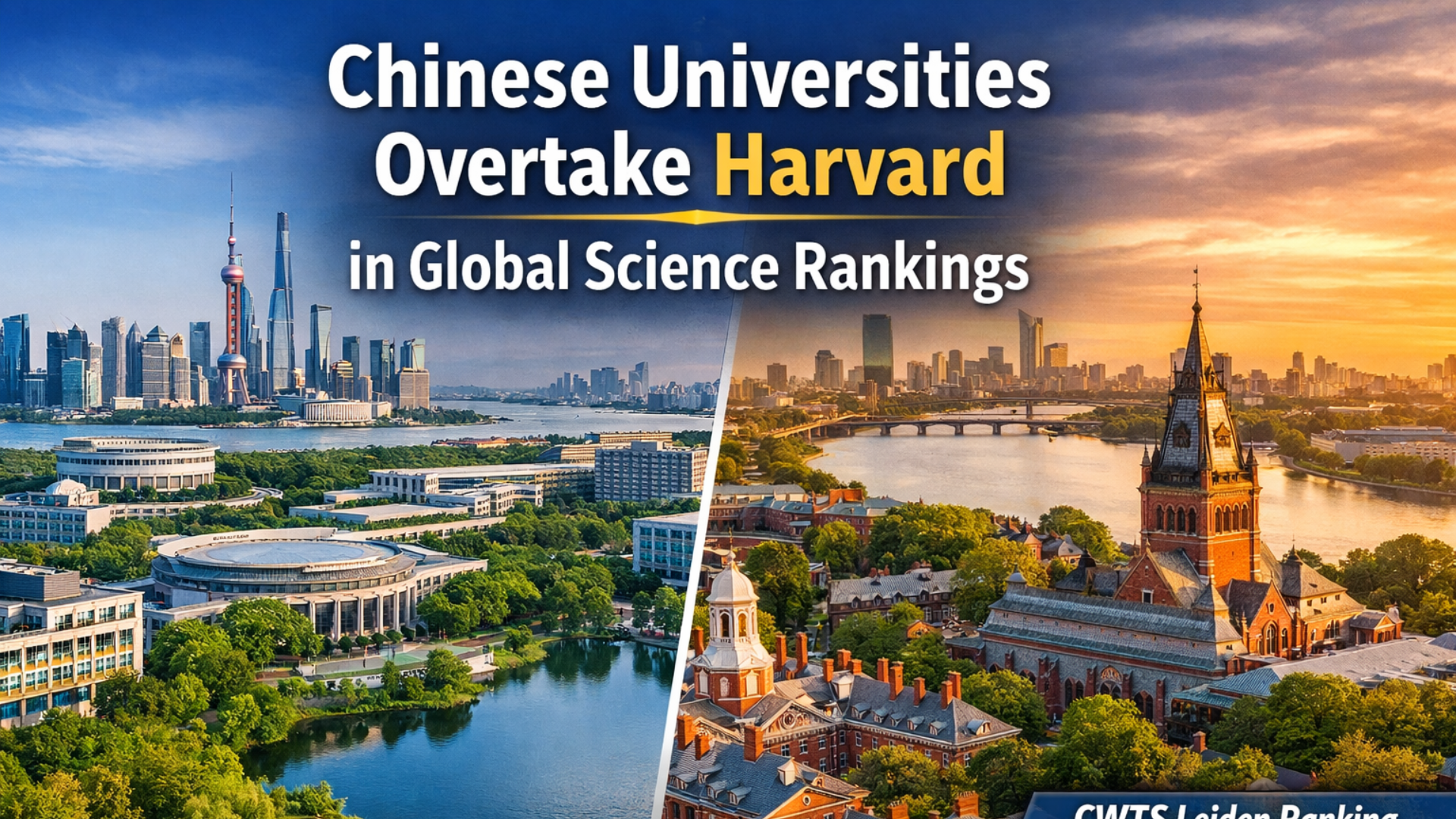

Chinese Universities Overtake Harvard in Global Science Rankings. Chinese universities have achieved a major milestone in global higher education, overtaking long-dominant U.S. institutions in the latest CWTS Leiden Ranking. For the first time in years, Harvard University has slipped to third place in the Science category, as Chinese institutions now claim most of the top positions.
The 2025 edition of the ranking places Zhejiang University at number one, followed closely by Shanghai Jiao Tong University in second place. Harvard, which once dominated global science rankings, now trails behind these two Chinese universities.
More notably, eight of the top nine universities in the Science category are now based in China, highlighting a dramatic shift in the global research landscape.
What Is the CWTS Leiden Ranking?
The CWTS Leiden Ranking is one of the world’s most respected university ranking systems focused exclusively on scientific research performance. It is produced by the Centre for Science and Technology Studies (CWTS) at Leiden University in the Netherlands.
Unlike rankings that rely heavily on reputation surveys, the Leiden Ranking is data-driven. It evaluates universities using bibliometric indicators drawn from the Web of Science database, including:

- Research output
- Scientific impact
- International collaboration
- Open access publishing
The ranking covers more than 1,500 major universities worldwide, making it one of the most comprehensive global assessments of scientific performance.
From U.S. Dominance to Chinese Leadership
When the first CWTS Leiden Ranking was released for the 2006–2009 period, U.S. universities dominated the global research scene. Harvard University held the top position, followed by the University of Toronto and the University of Michigan. American institutions occupied most of the top ten slots at the time.
However, the picture has changed significantly over the past decade.
Several prominent U.S. universities that once ranked among the global elite have now dropped out of the top fifteen. These include:

- University of Michigan
- University of California, Los Angeles (UCLA)
- Johns Hopkins University
- University of Washington, Seattle
- University of Pennsylvania
- Stanford University
This decline does not indicate a lack of research quality, but rather reflects the rapid expansion and rising output of universities in other regions, particularly China.
When Did Harvard Start Losing Ground?
Harvard’s position at the top was not lost overnight. The university maintained first place in the Science category for more than a decade, holding the lead consistently until the 2018–2021 ranking period.
The turning point came during the 2019–2022 rankings, when Zhejiang University surpassed Harvard for the first time. In the subsequent 2020–2023 edition, Harvard slipped further, settling into third place — a position it has now retained in the 2025 rankings.
These changes reflect long-term trends rather than short-term fluctuations.

Why Are Chinese Universities Rising So Fast?
The growing dominance of Chinese universities in global science rankings is driven by several key factors:
Massive Investment in Research
China has significantly increased funding for higher education and scientific research over the past two decades. Universities receive strong state support for laboratories, infrastructure, and large-scale research projects.
High Research Output
Chinese institutions produce a large volume of scientific publications, particularly in fields such as engineering, materials science, artificial intelligence, and medical research.
International Collaboration
Chinese universities are increasingly collaborating with global research partners, improving citation impact and visibility in international journals.

Strategic Focus on Rankings
Many Chinese universities actively align their research strategies with global ranking indicators, including those used by the Leiden Ranking.
What This Means for Global Higher Education
The latest CWTS Leiden Ranking confirms that global academic leadership is no longer concentrated in a single country. While U.S. universities remain influential, they now face strong competition from Asia, particularly China.
This shift has several implications:
- Students may see more Chinese universities gaining international recognition.
- Researchers may find increasing opportunities for collaboration with Asian institutions.
- Governments may reassess how research funding and policy shape global competitiveness.
The ranking also reinforces the importance of measuring universities by research performance rather than reputation alone.

Understanding the Leiden Ranking Traditional Edition
The Leiden Ranking Traditional Edition is based entirely on objective data from the Web of Science database. It does not include teaching quality, student satisfaction, or employer reputation.
Its purpose is clear:
to measure scientific performance and impact as accurately as possible.
This approach makes the ranking particularly influential among policymakers, researchers, and academic institutions focused on research excellence.
Conclusion
The latest CWTS Leiden Ranking highlights a clear shift in global scientific leadership, with Chinese universities surpassing long-dominant U.S. institutions like Harvard. Strong research investment and output have reshaped international rankings, signaling a more competitive and diversified global higher-education landscape driven by data, impact, and collaboration.