
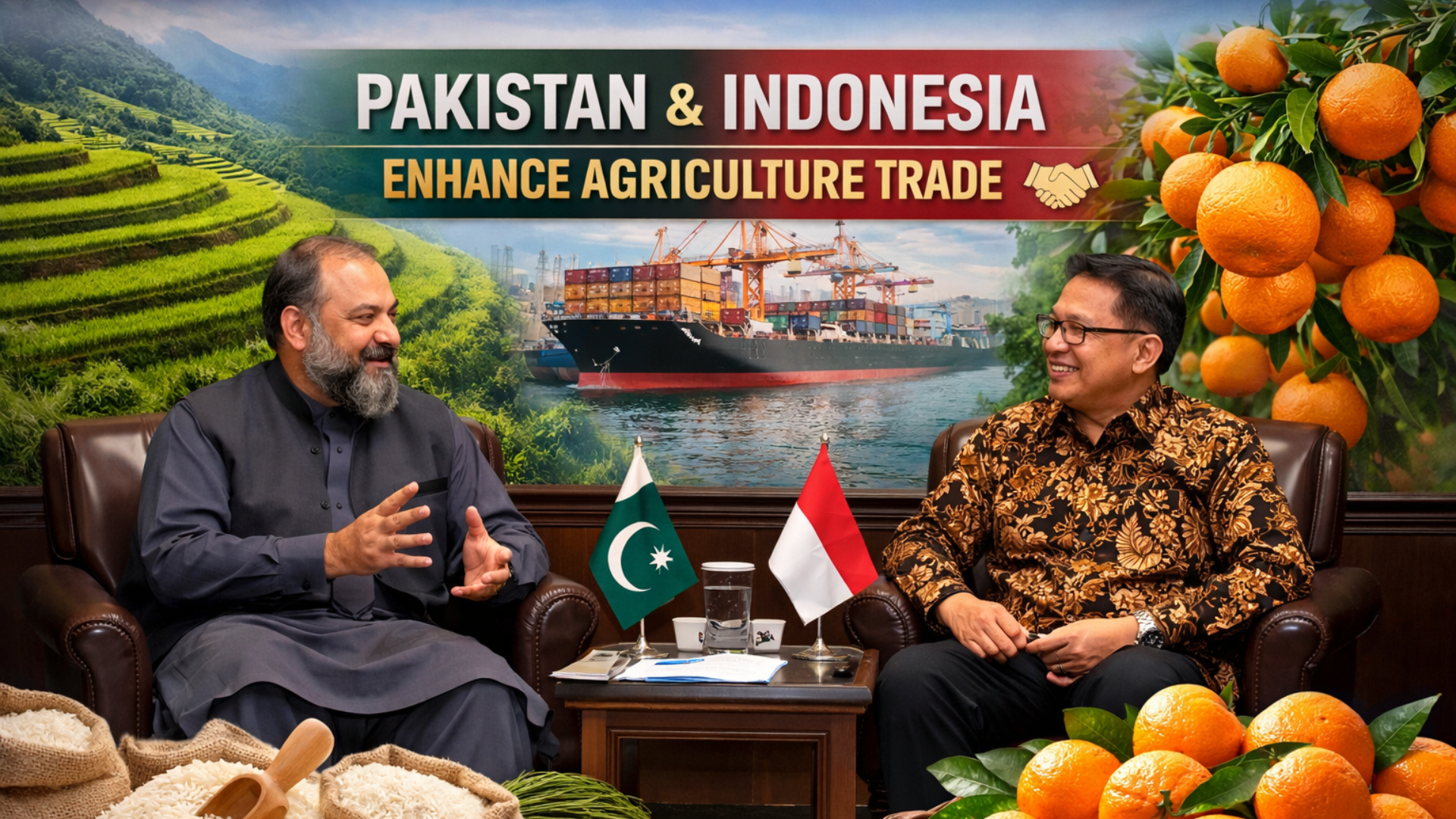

Pakistan, Indonesia Agree to Boost Trade Engagement in Agriculture. Pakistan and Indonesia have agreed to strengthen bilateral trade engagement with a strong focus on agriculture, particularly rice and citrus exports. The decision reflects a shared commitment to deepen economic cooperation and improve institutional coordination between the two countries.
The understanding was reached during a high-level meeting between Pakistan’s Federal Minister for Commerce Jam Kamal Khan and Indonesia’s Ambassador to Pakistan Chandra Warsenanto Sukotjo, according to an official statement released on Tuesday.
The talks emphasized early convening of the Joint Trade and Development Committee, activation of trade forums, and regular virtual consultations to maintain momentum in bilateral trade relations.
Strengthening Pakistan–Indonesia Agricultural Trade Ties
Agriculture remains a key pillar of economic cooperation between Pakistan and Indonesia, with rice and horticultural products playing a central role.
During the meeting, the commerce minister briefed the Indonesian envoy on Pakistan’s evolving trade strategy, highlighting reforms aimed at improving export competitiveness while maintaining international quality standards.

He noted that Pakistan is actively working on financial and commercial mechanisms to make its agricultural exports more price-competitive, without compromising on product quality. These measures are intended to help Pakistan retain and expand its market share in Indonesia and other key destinations.
Pakistan Position as a Leading Rice Exporter
Pakistan is among the world’s top rice exporters, supplying premium-quality basmati and non-basmati rice to global markets. The commerce minister reaffirmed that Pakistani rice meets internationally recognised quality benchmarks, making it a reliable option for food-importing countries.
Rice exports have long been a cornerstone of Pakistan–Indonesia trade relations. However, institutional arrangements governing rice trade have remained inactive in recent years, limiting the full potential of cooperation.
Revival of Rice MoU on the Agenda
Both sides recalled the rice memorandum of understanding (MoU) signed in 2015, which allowed Indonesia to procure up to one million metric tons of rice annually from Pakistan on a government-to-government basis. The agreement expired in 2019 and has not yet been renewed.

Pakistan has now shared a revised draft of the MoU with Indonesian authorities and expressed hope for its early finalisation. According to officials, reviving this framework would institutionalise long-term cooperation in rice trade and provide greater certainty to exporters and buyers on both sides.
For Pakistan, a renewed MoU could help stabilise export volumes, support farmers, and reduce exposure to market volatility. For Indonesia, it would ensure access to a dependable rice supplier at competitive prices.
Kinnow Exports and Market Access Concerns
Beyond rice, the commerce minister also raised concerns related to Pakistan’s citrus exports, particularly kinnow. Pakistan is one of the world’s largest producers and exporters of kinnow mandarins, and Indonesia is considered a promising seasonal market.
However, Pakistan is currently awaiting the issuance of import quotas by Indonesian authorities. The minister warned that delays in quota approvals could disrupt seasonal exports, leading to financial losses for growers and exporters.

He stressed that timely market access decisions are essential in agriculture, where export windows are short and perishable goods are involved.
Indonesia’s Focus on Food Security
The Indonesian ambassador welcomed Pakistan’s proposals and acknowledged the positive momentum generated by recent high-level exchanges between the two countries.
He assured that issues related to rice cooperation, agricultural market access, and trade facilitation would be conveyed to Jakarta. He also highlighted Indonesia’s strong interest in food security, diversified sourcing, and competitive pricing—areas where Pakistan’s agricultural sector can play an important role.
Indonesia, with its large population, continues to prioritise stable and diversified food imports to manage domestic demand and price stability.

Institutional Engagement to Drive Trade Growth
To ensure progress, both sides agreed to intensify institutional engagement through:
- Early meetings of the Joint Trade and Development Committee
- Regular trade forums involving public and private stakeholders
- Virtual consultations to address operational issues promptly
These mechanisms are expected to reduce bureaucratic delays, improve coordination, and provide structured platforms to resolve trade-related challenges.
Broader Economic Context
The renewed focus on trade engagement comes at a time when Pakistan is seeking to strengthen its external sector and boost exports to stabilise the economy. The government is also engaging with international partners, including the International Monetary Fund, to secure economic support while pursuing export-led growth.
Agriculture, which employs a large share of Pakistan’s workforce, remains central to this strategy.

Why This Agreement Matters
The Pakistan–Indonesia understanding is significant for several reasons:
- Export Growth: Renewed rice and citrus trade could increase Pakistan’s agricultural exports.
- Farmer Support: Stable export channels help protect farmers from price shocks.
- Food Security: Indonesia gains access to reliable, high-quality food supplies.
- Institutional Stability: Formal committees and forums reduce uncertainty in bilateral trade.
If implemented effectively, these measures could translate political intent into tangible economic outcomes.
Outlook for Pakistan–Indonesia Trade Relations
Both governments have signalled strong political will to deepen economic ties. The focus on early institutional meetings suggests that follow-up actions may come sooner rather than later.
Trade experts believe that finalising the revised rice MoU and resolving kinnow quota issues would be practical first steps. Over time, expanded cooperation could also open doors for collaboration in other agricultural products and value-added food exports.
Conclusion
Pakistan and Indonesia’s agreement to boost agricultural trade engagement marks a positive step toward revitalising bilateral economic relations. With rice, citrus, and food security at the centre of discussions, both countries stand to benefit from stronger institutional coordination and timely policy action.