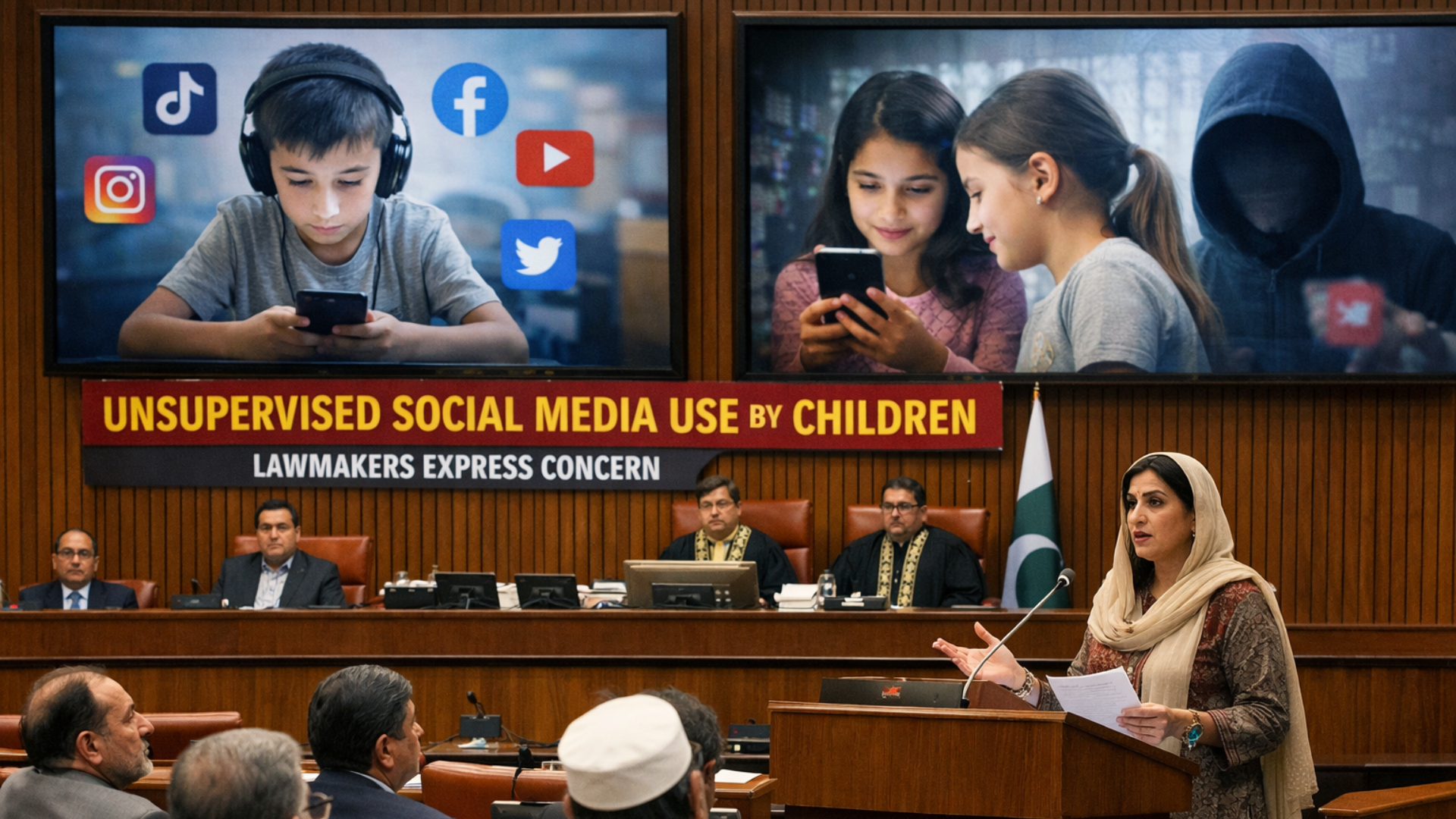

Action Against Unsupervised Social Media Use by Children. Pakistan’s lawmakers have raised serious concerns over the unsupervised and excessive use of social media by children, warning that the issue poses growing social, psychological, and legal risks. The matter was formally brought before the Senate of Pakistan, sparking calls for coordinated national action rather than fragmented policy responses.
The debate reflects increasing anxiety among parents, educators, and policymakers about how unrestricted access to digital platforms is shaping the behaviour, mental health, and safety of minors across the country.
Senate Notice Highlights Risks of Unmonitored Digital Exposure
The issue came under discussion after an attention notice was moved by Falak Naz, who urged the House to recognise the dangers associated with young children using social media without parental or institutional oversight.
In her notice, the senator pointed to the rapid rise in smartphone usage among minors and the lack of effective monitoring mechanisms. She stressed that children are increasingly exposed to harmful content, online predators, cyberbullying, and addictive digital behaviour at a very young age.
Lawmakers acknowledged that while social media offers educational and social benefits, unrestricted access for children carries serious long-term consequences if left unregulated.

Government Calls the Issue a National-Level Concern
Responding on behalf of the government, Tariq Fazal Chaudhry told the Senate that the problem was not minor or isolated. He described it as a national issue with wide-ranging social implications that deserved structured debate and policy-level intervention.
According to the minister, unsupervised digital exposure affects not only children but also families, schools, and society as a whole. He emphasised that the matter cannot be addressed by a single ministry or department, as it cuts across education, information technology, law, child protection, and social welfare.
He added that meaningful solutions would require collaboration between government institutions, lawmakers, parents, educators, and digital platforms.
Why Unsupervised Social Media Use Is a Growing Problem
Experts agree that children today are entering the digital world earlier than ever before. In Pakistan, affordable smartphones and cheap internet packages have made social media widely accessible, even for primary school-aged children.

Key concerns raised during the Senate discussion include:
- Exposure to inappropriate or harmful content
- Cyberbullying and online harassment
- Digital addiction and excessive screen time
- Decline in academic focus and physical activity
- Mental health issues such as anxiety and low self-esteem
- Privacy risks and data exploitation
Without guidance, children often lack the emotional maturity to understand online risks or set healthy digital boundaries.
Sensitive Issue Requires Multi-Ministry Oversight
Presiding Officer Sherry Rehman described the matter as highly sensitive, noting that it could not be referred to the IT committee alone.
She explained that multiple government bodies are involved, including education authorities, child protection agencies, and legal institutions. On the direction of the Chairman of the Senate, she announced that a special committee should be formed to examine the issue in depth.

The committee is expected to review existing laws, assess international best practices, and recommend policy measures tailored to Pakistan’s social and cultural context.
Role of the Ministry of Law and Legal Gaps
The Senate was informed that input would also be sought from the Ministry of Law, highlighting the legal dimensions of the issue.
Currently, Pakistan lacks comprehensive child-specific digital safety legislation. While some cybercrime laws exist, they do not fully address parental controls, age verification, platform accountability, or child-focused digital protections.
Lawmakers signalled that any future framework must balance child safety with constitutional rights, digital access, and freedom of expression.

Global Context: How Other Countries Are Responding
Several countries have already introduced stricter controls on children’s social media use. These include:
- Mandatory parental consent for underage accounts
- Age-verification requirements for platforms
- Limits on targeted advertising to minors
- Screen time restrictions and default privacy settings
- Heavy fines for platforms that fail to protect children
During informal discussions, senators noted that Pakistan could learn from such models while adapting them to local realities.
Parents and Schools Also Share Responsibility
While lawmakers debated policy responses, many senators acknowledged that government action alone is not enough. Parents, guardians, and schools play a central role in shaping healthy digital habits.
Key recommendations discussed include:

- Encouraging parental monitoring and open communication
- Teaching digital literacy in schools
- Promoting age-appropriate internet use
- Raising awareness about online risks
- Limiting screen time at home
Without active parental involvement, even the strongest regulations may fail to protect children effectively.
Social Media Platforms Under the Spotlight
Another critical aspect raised indirectly during the debate was the responsibility of social media companies themselves. Senators stressed that platforms must do more to prevent underage usage, harmful content exposure, and addictive design practices.
There were calls for stronger cooperation between regulators and tech companies, including clearer reporting mechanisms, local compliance offices, and transparency in content moderation policies.What Happens Next
The formation of a special Senate committee marks the first formal step toward structured policy development on this issue. Once established, the committee is expected to:
- Consult relevant ministries and experts
- Review existing laws and regulations
- Study international child online safety frameworks
- Propose legislative or regulatory reforms
- Recommend awareness and education initiatives
Any final recommendations would then be presented to the Senate for debate and possible implementation.
Conclusion
The Senate’s discussion on unsupervised social media use by children reflects a growing national awareness of the risks associated with unchecked digital exposure. By acknowledging the issue as sensitive, complex, and multi-dimensional, lawmakers have signalled that piecemeal solutions are no longer sufficient.